

High-Quality Material Usage: Repairs & Renovations

Table of Contents
Why High-Quality Materials Matter for Repairs and Renovations
Historic Masonry Restoration Materials: Matching the Original
Lime Mortar for Historic Brick: Why Soft Mortars Win
Durable Roofing Materials for Homes in the Tri-State Area
Siding Materials for Historic Homes: Balancing Authenticity and Performance
How to Verify Material Quality and Supplier Claims
Regional Codes, Permits, and Historic-District Approvals
What typically triggers a permit
What historic review usually asks for
A practical sequence that avoids delays
Conclusion: Choosing the Right Materials for Your Project
Frequently Asked Questions
Last Updated: October 8, 2026
Why High-Quality Materials Matter for Repairs and Renovations
Walk through any older neighborhood in this region and you can spot the shortcuts from a block away: crumbled mortar joints, siding that waves in the wind, roofs that shed granules like confetti after a single winter, all signs that high-quality materials were skipped.
At J&L Construction & Restoration, we have spent over two decades watching that difference play out on job sites.
This guide covers what we have learned about material selection for both historic and residential properties, from lime mortar to roofing to siding, plus how to verify that what you are buying is actually what the supplier claims.
Key Takeaway The single biggest driver of premature failure in this region is not workmanship. It is incompatible materials: hard modern products installed against soft historic substrates, each expanding and contracting at a different rate until something cracks.
Historic Masonry Restoration Materials: Matching the Original
Historic masonry restoration materials must match the physical properties of the original assembly, not just its color.
Here is the mechanism, and it matters for your decision: historic brick is comparatively soft and porous. Lime mortar is softer still, so it acts as the sacrificial element.
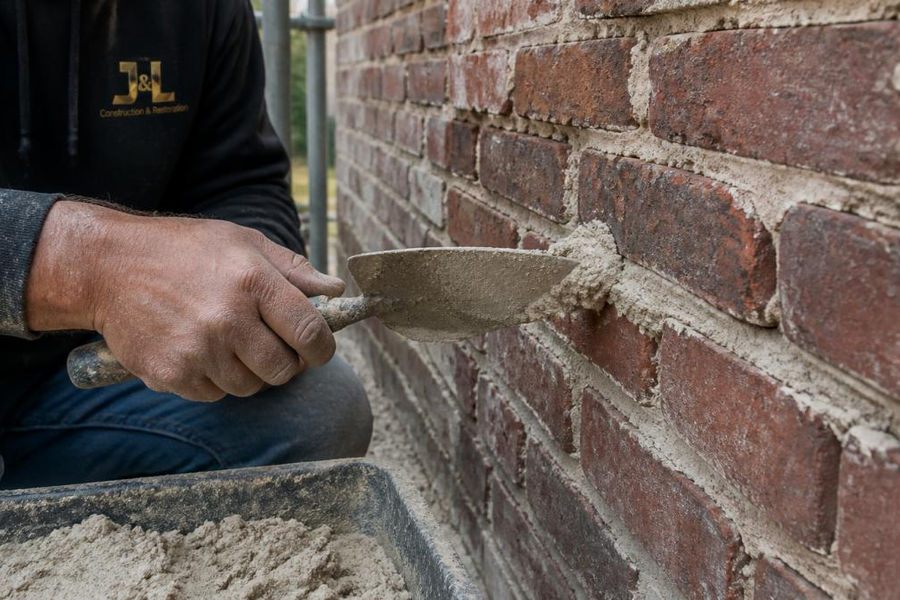
What most guides miss is that "matching" involves more than composition. For landmark and historic-district work, the National Park Service Preservation Briefs on repointing mortar joints remain the standard reference for evaluating mortar compatibility, and they are worth reading before you approve any scope of work.
Lime Mortar for Historic Brick: Why Soft Mortars Win
Lime mortar for historic brick wins because it moves with the building. It is more flexible, more vapor-permeable, and more forgiving than cement. Those three properties are exactly what a century-old masonry wall needs.
A practical comparison helps here:
Property | Lime Mortar | Portland Cement Mortar |
Compressive strength | Low, matches soft brick | High, can crush historic units |
Vapor permeability | High, allows wall to dry | Low, traps moisture |
Flexibility | Moves with thermal cycling | Rigid, cracks under movement |
Repairability | Easy to remove and redo | Difficult, damages brick on removal |
Best for | Pre-1930s masonry | Modern structural masonry |
The trade-off is real. Lime mortar cures more slowly, is more sensitive to temperature and moisture during installation, and requires a mason who actually knows the material.
Watch Out Never let a contractor "improve" a lime mortar specification by adding a splash of portland cement for strength. That small addition can push the mortar's compressive strength past the brick's, and the next freeze will take it out on the masonry units instead of the joint.
Durable Roofing Materials for Homes in the Tri-State Area
Durable roofing materials for homes in this region need to survive two things above all: freeze-thaw cycling and ice damming. A roof that performs fine in a mild climate can fail here within a few winters.
Here is how the main options actually compare on the variables that matter here:
Material | Typical service life | Relative weight | Maintenance profile | Best fit |
Standing seam metal | Long, often several decades | Light | Low; recoating and fastener checks | Low-slope and steep-slope, snow sheds well |
Natural slate | Very long, often 75+ years | Heavy | Low but repairs need skilled labor | Steep historic roofs with adequate structure |
Clay or concrete tile | Long | Heavy | Low; brittle under foot traffic | Steep roofs, Mediterranean and revival styles |
High-grade asphalt shingle | Moderate, roughly 20-30 years | Light | Moderate; granules and flashing wear | Budget-driven replacements, most pitches |
Synthetic slate or composite | Long | Light to moderate | Low | Historic look without slate's weight |
Wood shake or shingle | Moderate | Light to moderate | High; needs treatment and clearing | Historic and rustic aesthetics |
Three trade-offs drive most decisions:
Weight versus structure. Historic structures often have rafters sized for lighter original roofing. Slate and tile can be two to three times heavier than asphalt, so adding them without an engineering review is a structural risk. Synthetic slate and composite products exist largely to solve this problem.
Snow shedding versus ice damming. Metal sheds snow well but can dump it onto walkways and lower roofs. Asphalt and slate hold snow longer, which raises the stakes on ice-dam protection at the eaves. That membrane detail matters more than the surface material in most failures we correct.
Repairability versus lifespan. Slate and tile last longest but require matching salvaged or new units and a roofer who knows the system. Asphalt is easy to patch but has the shortest life. Metal sits in between.
What we look for in any roofing assembly comes down to a few variables:
Impact and thermal resistance. Materials that stay flexible in cold weather resist cracking when temperatures drop.
Ice-dam protection at the eaves. This is a detail, not a material, but it is the single most common source of interior water damage we correct.
Fastener and flashing compatibility. Mixing metals incorrectly creates corrosion that undermines an otherwise sound roof.
Ventilation and underlayment. Intake and exhaust balance, plus a properly specified underlayment, determine whether the assembly dries or traps moisture.
The honest answer on material choice is that there is no universal winner. Standing seam metal, slate, and high-grade asphalt each have a defensible case depending on roof pitch, structure, and budget.
Pro Tip Ask for the roof assembly in writing: surface material, underlayment, ice-dam membrane, flashing metals, fasteners, and ventilation. If any of those is missing from the proposal, the material brand is not the problem.
Siding Materials for Historic Homes: Balancing Authenticity and Performance
Siding materials for historic homes force a genuine trade-off, and anyone who tells you otherwise is selling something. You are balancing visual authenticity against weather performance and maintenance.
Wood clapboard remains the most authentic choice for most pre-war homes in this region, and modern factory finishes have meaningfully extended its service life compared to the paint-and-repaint cycle of decades past.
Where homeowners get burned is on the details rather than the material.
Pro Tip Ask any siding contractor to show you their flashing detail at a window head before you sign. If they cannot produce a drawing or explain how water exits that assembly, the material spec is irrelevant.
How to Verify Material Quality and Supplier Claims
Verifying material quality comes down to documentation and physical inspection, not sales conversation. Suppliers who stand behind their products make verification easy. The ones who resist are telling you something.
Use this checklist before accepting delivery on any significant material order:
Request the manufacturer's published specification sheet, not a marketing brochure
Confirm the product carries a current evaluation report or listing from a recognized testing body where applicable
Check that the delivered material matches the specified grade, class, and dimensions on the packing slip
Inspect a sample from the actual delivery, not a showroom sample
Verify batch or lot numbers on masonry and mortar products, since color and composition vary between runs
Ask for the supplier's return and defect policy in writing before the order ships
Confirm delivery logistics and site access requirements, because damaged-on-arrival material is a dispute you want to avoid
ASTM International standards for building materials testing publishes the test methods behind most material specifications. Knowing which standard applies to your product lets you ask a supplier a question they cannot deflect.
Regional Codes, Permits, and Historic-District Approvals
Regional codes and historic-district approvals shape what materials you are permitted to use, sometimes more than budget does. This is the step homeowners most often underestimate, and it is the one that can stall a project for months.
Approval requirements vary significantly by municipality and by whether the property sits in a designated historic district. A few practical realities apply across the region:
Work visible from the street in a historic district usually requires review before any material is ordered. That includes roof covering changes, window replacement, siding, and sometimes paint color.
Structural alterations, roof replacements, and window changes commonly trigger permitting regardless of district status.
Documentation quality drives approval speed. Photographs, material samples, and clear scope drawings move applications faster than narrative descriptions.
Code requirements for safety, egress, and structural performance apply even where historic-preservation rules allow material flexibility.
What typically triggers a permit
Roof replacement or structural roof repair
Window and exterior door replacement
Siding replacement or re-cladding
Additions, dormers, and structural alterations
Electrical, plumbing, and mechanical changes
Masonry work that affects structural capacity
What historic review usually asks for
A scope that states the existing material and the proposed replacement
Photographs of the existing condition, taken from the street and up close
Material samples or cut sheets showing profile, color, and texture
A statement of how the proposal preserves the character-defining features
A practical sequence that avoids delays
Confirm the property's district status and any local overlay requirements with the authority having jurisdiction.
Pull the current application forms and checklist, since these change.
Assemble photographs, samples, and drawings before submitting.
Submit early, and plan for at least one round of comments.
Do not order material until the approval is in hand, because substitutions after approval often require re-review.
Because these rules are set locally and change, we always confirm current requirements with the authority having jurisdiction before finalizing a material order. U.S. Department of Housing and Urban Development guidance on residential rehabilitation offers useful background on rehabilitation standards, though your local building department is the binding authority.
Watch Out Ordering material before approval is the most common and most expensive mistake in historic-district work. If the review board asks for a different profile or color, non-returnable material becomes a sunk cost.
Conclusion: Choosing the Right Materials for Your Project
The hardest part of any renovation is not picking a product.
J&L Construction & Restoration handles roofing, masonry, carpentry, painting, welding, and siding under one roof, with over two decades of experience across commercial and residential projects in New York, New Jersey, and Pennsylvania.
Contact us to walk your property, review your material options, and get a scope you can actually plan around.
Frequently Asked Questions
What are the best materials for repairing historic masonry?
The best materials for historic masonry restoration are those that match the original in composition, strength, and vapor permeability. Lime-based mortars, natural stone, and historically accurate brick are preferred because they allow moisture to escape and move with the structure. Using modern Portland cement on historic brick can trap moisture and cause spalling. For high-quality materials, work with a contractor experienced in historic restoration who can source compatible supplies.
Why should repair materials match the original materials in a historic building?
Mismatched materials can cause serious damage. Historic brick and stone are softer and more porous than modern equivalents. If you repair with harder modern mortar, it forces moisture to evaporate through the brick instead, leading to cracking and deterioration. Matching original materials preserves the building's structural integrity and appearance. It also helps with historic-district approvals, as review boards often require material compatibility.
How do I choose durable roofing materials for a historic home?
Durable roofing materials for historic homes must balance longevity with visual compatibility. Slate, clay tile, and standing-seam metal are common choices that last decades. Asphalt shingles can work if they mimic the original look. Check local historic-district guidelines before selecting. Also verify that the roofing contractor has experience with your specific material, because installation quality affects durability as much as the product itself.
What siding materials work best for historic homes?
Siding materials for historic homes should match the original profile and texture. Wood clapboard, cedar shingles, and fiber-cement boards that replicate wood are common. Vinyl siding is generally discouraged in historic districts because it changes the appearance and can trap moisture. Always confirm approval with your local historic preservation commission. High-quality materials and proper installation prevent premature failure and maintain property value.
How can homeowners compare the durability and maintenance needs of renovation materials?
Compare materials by lifespan, maintenance frequency, and climate suitability. For example, slate roofing lasts 75+ years but needs structural support, while asphalt lasts 20 years with minimal upkeep. Ask suppliers for product data sheets and warranties. Request references from local projects. In the tri-state area, freeze-thaw cycles and moisture make vapor permeability and frost resistance critical factors for any exterior material.
How do I verify a contractor actually uses high-quality materials?
Ask for material specifications and supplier names before work begins. Request samples or photos of materials on site. A trustworthy contractor will welcome third-party inspections and provide written warranties on both labor and materials. Check if they are licensed and insured in your state. For historic projects, ask about previous restoration work and whether they follow the Secretary of the Interior's Standards for Rehabilitation.
CONTACT US


Comments