

How to Apply for Historic Home Restoration Grants 2026

Table of Contents
Understanding Historic Home Restoration Grants
Historic Preservation Grant Eligibility Requirements
Income Limits and Household Qualifications
Property and Historic Designation Requirements
What Restoration Work Qualifies for Funding
Historic Preservation Grant Application Checklist
Required Documents and Supporting Materials
Step-by-Step Application Submission Process
Historic Home Restoration Matching Funds and Grant Stacking
Historic Home Restoration Project Budget Planning
Application Deadlines and Funding Cycles for 2026
After Approval: Preservation Standards and Project Execution
Frequently Asked Questions
Last Updated: October 13, 2026
Understanding Historic Home Restoration Grants
Historic home restoration grants are financial assistance programs that help property owners preserve and rehabilitate buildings with historical significance. They come from federal, state, and local sources.
The key is understanding which grants match your property type and planned work.
Historic preservation grant programs typically fall into three categories: federal grants administered through state agencies, state-specific funding, and local government incentives. Each has different eligibility rules, application processes, and funding amounts. Some focus on exterior work like roofing and masonry; others support interior restoration or structural repairs.
These programs offset costs that might otherwise make restoration financially unfeasible, since historic properties often require specialized work that costs more than modern construction.
Pro Tip Not all restoration work qualifies for funding. Grants typically cover work that preserves historic character and follows preservation standards. Modern additions, interior updates for personal preference, or routine maintenance usually don't qualify. Know what qualifies before you apply.
Historic Preservation Grant Eligibility Requirements
Your property and household must meet specific criteria to qualify for historic home restoration grants, most commonly property designation, income limits, and the type of work planned.
Income Limits and Household Qualifications
Income-qualified homeowner programs are the most accessible grants for residential properties. They target households below certain income thresholds, which vary by program and location.
Most federal historic preservation grants use area median income (AMI) as the benchmark. A typical program serves households at or below 80% of AMI; some are more restrictive, serving only those below 50% or 60% of AMI.
You'll need to document household income when you apply, providing recent tax returns, W-2 forms, or other verification. The calculation includes all household members.
Watch Out Income limits change annually and vary by county. Using outdated figures can disqualify your application. Verify current limits with the administering agency before you start the application process.
Property and Historic Designation Requirements
Your property must have historic significance to qualify: it's listed on the National Register of Historic Places, located in a local historic district, or individually designated as historic by your local preservation office.
Not every old building qualifies. The property must meet architectural or historical criteria established by preservation standards, verified by a preservation professional.
You'll need documentation of the property's historic designation, a National Register listing, a local historic district boundary map showing your address, or a local designation certificate. If your property isn't formally designated, some programs allow you to nominate it during the application.
The property owner must own the building outright or hold a long-term interest in it, and most programs require it be your primary residence or a qualifying use like a nonprofit's office.
What Restoration Work Qualifies for Funding
Eligible work must preserve or restore the property's historic character while following established preservation standards.
Common eligible work includes exterior repairs like roof replacement with period-appropriate materials, masonry restoration and tuckpointing, window restoration or replacement with historically appropriate units, siding repair, and foundation stabilization. Qualifying interior work includes structural repairs, restoration of historic woodwork and trim, and rehabilitation of original systems like plumbing or electrical where necessary for safety.
Work that typically does NOT qualify includes cosmetic updates, modern exterior additions, kitchen or bathroom remodels for personal preference, and routine maintenance. The distinction is whether the work preserves historic character or merely updates for contemporary comfort.
Before investing time in an application, understand that your planned work must align with the program's preservation standards. Requirements vary: some programs are stricter about original materials, while others allow compatible modern materials when originals aren't available.
Key Takeaway The best approach is to have a preservation professional review your project scope before you apply. They can confirm that your planned work meets preservation standards and qualifies for funding. This step saves time and prevents rejected applications.
Historic Preservation Grant Application Checklist
A successful application requires careful preparation. Most programs require the same core documents, though specifics vary.
Required Documents and Supporting Materials
Start by gathering property documentation: a copy of the deed, property tax assessment, and photographs showing current condition. Most programs ask for photos of all exterior elevations and close-ups of areas needing work.
Next, document the property's historic significance, the National Register listing, or a local historic designation certificate. If your property isn't formally designated, you'll need a historic assessment by a qualified professional.
Your project scope must be documented in detail: a written description of the planned work and materials, plus contractor quotes and cost estimates for each component.
Financial documentation includes proof of household income (recent tax returns or pay stubs) and proof of ownership, typically a copy of the deed.
Some programs require a preservation review before approval: a certified local government or State Historic Preservation Office (SHPO) reviews your project to confirm it meets preservation standards. This happens during the application process.
Application Documents Checklist:
Property deed and proof of ownership
Current property tax assessment
Photographs of property (all exterior sides, detail shots of damage)
Historic designation documentation (National Register listing or local certificate)
Written project scope describing all planned work
Contractor cost estimates for each work item
Proof of household income (tax returns, W-2s, or pay stubs)
Proof of residency if property is your primary residence
Preservation standards compliance statement
Project timeline and budget summary
Step-by-Step Application Submission Process
The application process varies by program, but most follow a similar structure.
Step 1: Identify Eligible Programs
Determine which programs match your property and project.
Track program names, deadlines, income limits, and maximum grant amounts in a spreadsheet to prioritize applications.
Step 2: Verify Your Property's Eligibility
Confirm your property meets the historic designation requirement. If it's already listed on the National Register or designated locally, gather that documentation.
Contact your local preservation office or State Historic Preservation Office, they can confirm whether your property qualifies and what documentation you'll need.
Step 3: Define Your Project Scope
Have a preservation professional review your scope to confirm it meets the program's standards.
Step 4: Gather Documentation
Collect all required documents before starting the application: ownership documents, income verification, historic designation paperwork, property photographs, and contractor estimates.
Step 5: Complete the Application
Most programs offer online applications or downloadable forms.
Attach all required supporting documents, ensuring they're clear and readable.
Step 6: Submit and Track
Submit your application before the deadline and keep a copy for your records.
Follow up with the administering agency to confirm receipt, and ask about the decision timeline and how you'll be notified.
Historic Home Restoration Matching Funds and Grant Stacking
Many homeowners don't realize they can combine multiple funding sources for a single project, significantly increasing available funding.
Matching funds requirements mean the grant covers a percentage of eligible costs and you cover the rest. A common structure is 50/50 matching; some programs offer 60/40 or 75/25 splits.
Grant stacking means combining multiple grants for the same project, for example, a federal grant for exterior work and a state grant for interior work. Some programs allow this, others restrict it, so always check the rules.
Tax credits work alongside grants in many cases. Federal and state historic preservation tax credits let property owners deduct a percentage of qualified rehabilitation costs from their taxes, and most programs allow combining them with grants.
When planning your budget, consider all available funding sources. A project might combine a grant covering 40%, your matching funds, a tax credit covering 20%, and a preservation loan for the remainder, a layered approach that makes larger projects feasible.
Pro Tip Document every funding source you use. Mixing grants and tax credits requires careful record-keeping. Mistakes in documentation can result in having to repay funding. Work with your accountant and the grant administrator to ensure compliance.
Historic Home Restoration Project Budget Planning
A realistic budget is the foundation of a successful restoration project. Historic properties often reveal unexpected issues during work, so build in contingency.
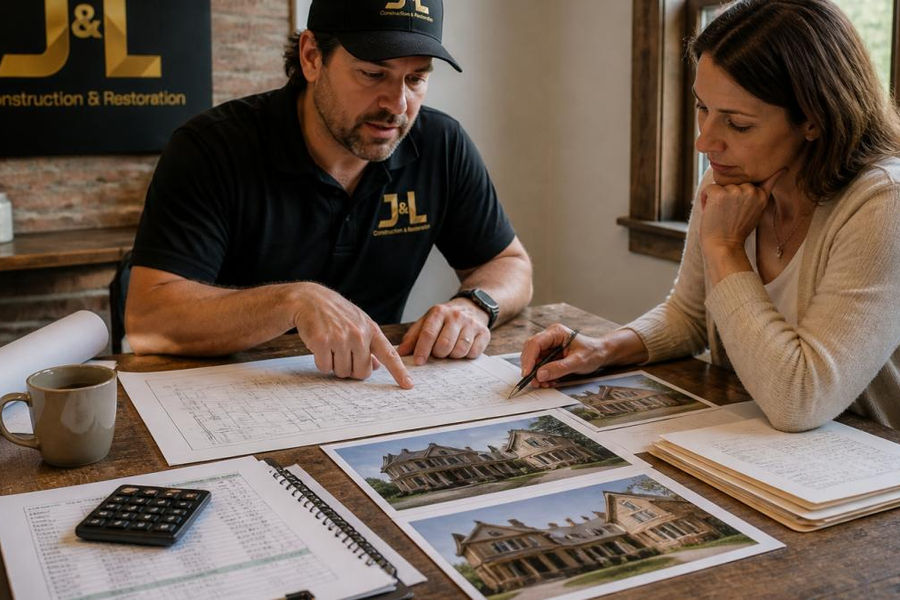
Start by getting detailed cost estimates from qualified contractors experienced in preservation, since historic restoration requires specialized skills.
Add a contingency of 15-25% of total project cost to cover unexpected structural issues, hidden damage, or unavailable materials.
Your budget should include permits, inspections, and preservation review. These administrative costs often surprise homeowners and may add 5-10% to your total project cost.
Consider the timeline when budgeting. A longer timeline can reduce costs if you can phase the work. However, some work must be done together.
When you apply for grants, your budget becomes part of your application. Be realistic: underestimating hurts credibility, while overestimating can reduce your award.
Application Deadlines and Funding Cycles for 2026
Grant programs operate on funding cycles. Missing a deadline means waiting until the next cycle, months or even a year away.
Most federal programs administered through state agencies have annual deadlines. Some accept applications on a rolling basis until funding runs out; others have a single annual deadline. Check with your State Historic Preservation Office for the current schedule.
Local programs often have different deadlines than state programs. Some accept applications year-round; others have specific windows. Contact your local preservation office for their schedule.
Mark all relevant deadlines on your calendar. Applications typically require several weeks to prepare, and rushed submissions often contain errors that lead to rejection.
Many programs publish funding cycles and deadlines in advance. Check program websites in October or November for next year's schedule, giving you time to plan and prepare.
If you miss a deadline, ask when the next application period opens. Some programs are quarterly, others annual, knowing the next deadline helps you plan your project timeline.
Watch Out Deadlines are firm. Late applications are not accepted, regardless of circumstances. Submit early enough that technical issues or unexpected delays don't cause you to miss the deadline.
After Approval: Preservation Standards and Project Execution
Once your grant is approved, the process isn't finished. Grant programs require work to be completed according to preservation standards and the approved project scope.
Most programs require final approval from a preservation professional before work begins, a preservation review or Section 106 review, depending on the funding source.
Keep detailed records of all work and expenses.
After completion, some programs require you to maintain the property according to preservation standards for a specified period, often 10 years or more (Easements, Covenants, and Preservation Agreements).
Our relationship with you continues through project completion. J&L Construction & Restoration understands preservation standards and works within them, documenting thoroughly to help ensure your project meets all grant requirements.
Restoring a historic property is a significant undertaking, but grants make it achievable. J&L Construction & Restoration has guided property owners through this process for over two decades.
Frequently Asked Questions
How do I apply for a historic home restoration grant?
Start by confirming your property qualifies for historic designation through your State Historic Preservation Office or local preservation office. Gather required documents including property photos, historical documentation, and restoration plans. Complete the grant application form (requirements vary by program), submit supporting materials before the deadline, and track your application status. Most programs require submission to your state or local preservation office, which reviews applications against program criteria and eligibility requirements.
What documents do I need for a historic preservation grant application checklist?
Essential documents typically include proof of property ownership, income verification for income-qualified homeowner programs, property tax records, photographs of current condition and damage, historical documentation proving historic designation or register listing, detailed restoration plans with scope of work, contractor estimates or bids, proof of historic district or National Register status, and any required certifications from preservation professionals. Check your specific program's requirements, as some may need additional materials like architectural drawings or environmental assessments.
Do historic home restoration projects require matching funds?
Many historic home restoration matching funds programs require homeowners to contribute a percentage of project costs, typically 10-50% depending on the program. Some grants cover 100% of eligible work, while others use a matching formula. Matching funds can come from your own resources, loans, tax credits, or other grant programs (grant stacking). Verify matching fund requirements in your program's guidelines before applying, as this affects your overall project budget and funding strategy.
Who is eligible for historic preservation grants?
Eligibility for historic preservation grant eligibility varies by program but generally requires property ownership, proof that the property is historically designated or listed on the National Register, and income qualification for some programs. The property must meet preservation standards and the restoration work must comply with Secretary of Interior Standards. Some programs prioritize owner-occupied residences or properties in certified local governments. Contact your State Historic Preservation Office to confirm which programs match your property type and ownership status.
CONTACT US
Comments