

How to Plan a Whole House Remodel Step by Step

Table of Contents
Step 1: Define Your Project Scope and Goals
Step 2: Create a Home Renovation Budget Template
Financing Your Whole House Remodel
Step 3: Understand How Long Does a Whole House Remodel Take
Step 4: Navigate Residential Renovation Permit Requirements
Step 5: Start Hiring a General Contractor for Home Renovation
Step 6: Plan the Construction Sequence and Prepare Your Home
Step 7: Manage Your Whole House Remodel and Plan for Life During Construction
Communication and Project Management
Living Through Construction: Practical Logistics
Frequently Asked Questions
Last Updated: October 3, 2026
A well-planned whole house remodel anticipates problems before they happen, gives you control over costs, and keeps your life manageable during construction. The difference between projects that succeed and those that spiral comes down to preparation.
This guide covers defining your scope, building a realistic budget, understanding timelines, navigating permits, hiring a contractor, and managing life during construction.
Step 1: Define Your Project Scope and Goals
Write down every room and system involved: roof, foundation, load-bearing walls, mechanicals, electrical, kitchen, bathrooms, flooring. Is this structural or cosmetic? The scope directly drives budget, timeline, and contractor selection.
List priorities in order. Budget constraints force choices: kitchen or bathrooms first? New windows or roof? A clear hierarchy prevents decision paralysis mid-project.
Consider your lifestyle during construction. Are you staying in the house? Do you have young children or pets? These affect which rooms get done first. A family with young kids might prioritize finishing one bathroom and the kitchen early, even if the logical sequence suggests otherwise.
Step 2: Create a Home Renovation Budget Template
A budget template prevents the most common mistake: underestimating costs and facing impossible choices mid-project.
Start with hard numbers for each category:
Labor: General contractor fees, subcontractors for electrical, plumbing, HVAC, carpentry, painting, masonry, or any specialized trades
Materials: Finish materials (flooring, fixtures, cabinetry), structural materials (framing, insulation, drywall), mechanical components (electrical wiring, plumbing fixtures, HVAC equipment)
Permits and inspections: Building permits, inspections at various phases
Design and engineering: Architectural plans, structural engineering if load-bearing walls are involved
Contingency fund: The line item most homeowners skip, and regret
Build your contingency fund as 15-20% of your total budget. Unexpected issues emerge during demolition: hidden mold, outdated wiring, structural damage. A contractor who promises no surprises is either inexperienced or dishonest.
Track every estimate in a spreadsheet with date, scope, contractor name, and total. This protects you when comparing bids and if disputes arise.
Financing Your Whole House Remodel
Once you've calculated your total project cost, you need to determine how to pay for it. Most homeowners don't have the full amount in savings, and that's where renovation financing comes in. Understanding your options before you start prevents mid-project funding crises.
FHA 203(k) Loans roll purchase price and renovation costs into a single mortgage loan. Funds are disbursed in stages as work is completed and inspected. This protects both you and the lender. The downside: more involved application process, and not all lenders offer them. Ideal if you're buying a fixer-upper.
Home Equity Lines of Credit (HELOCs) let you borrow against home equity with flexible draw schedules. Variable rates mean payments increase if rates rise, and available credit shrinks if home value drops.
Construction Loans are short-term loans with funds disbursed in stages. Once complete, you refinance into a traditional mortgage. Higher rates than mortgages, but you pay interest only on drawn funds. Disadvantage: eventual refinancing adds closing costs.
Cash-Out Refinancing lets you refinance for more than you owe and pocket the difference. Locks in a fixed rate but increases total mortgage debt.
Personal Savings and Home Improvement Loans are faster options without appraisals, but carry higher interest rates than home-secured loans.
Choose the financing method that matches your timeline and risk tolerance. Discuss options with a mortgage broker before finalizing your budget, the method affects your total cost and monthly payment.
Step 3: Understand How Long Does a Whole House Remodel Take
A whole house remodel typically runs 4-8 months, sometimes longer if structural changes are involved. Timeline depends on scope, complexity, and how many trades work simultaneously.
Grace In My Space
Key phases: planning/permitting (2-6 weeks), demolition (1-3 weeks), rough-in (4-8 weeks), framing (2-4 weeks), drywall (3-6 weeks), final trades (2-4 weeks). Weather, permits, and contractor availability affect timelines. The best contractors book 2-3 months out.
Be skeptical of unrealistically fast timelines. A realistic contractor explains the sequence and dependencies: rough-in before drywall, drywall before painting.
Step 4: Navigate Residential Renovation Permit Requirements
Building permits ensure electrical safety, code-compliant plumbing, and structural integrity. Skipping permits is a mistake that haunts you at resale or with insurance claims.
Most areas require permits for electrical, plumbing, HVAC, structural changes, and additions (Consumer Safety). Cosmetic work may not require permits, check with your local building department. Permit costs are minimal compared to liability of unpermitted work.
Your contractor typically handles permits, but verify they're obtained. Inspections occur at key phases: after framing, rough-in, and before final finishes.
Step 5: Start Hiring a General Contractor for Home Renovation
Hiring a general contractor is your most important decision. A great contractor coordinates subcontractors, manages schedules, communicates, and delivers quality work.
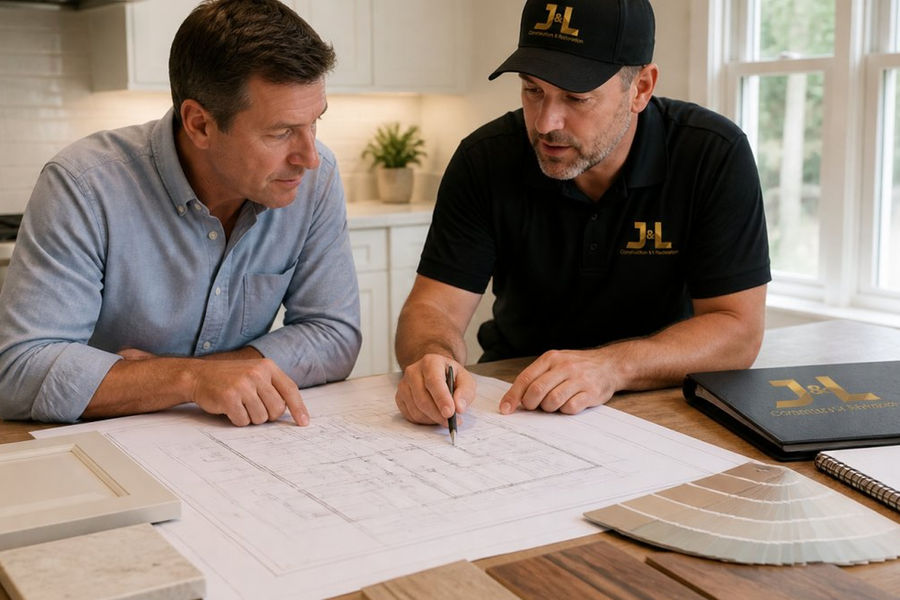
Interview at least three contractors and call references. Ask: Did the project stay on budget? Finish on time? How were problems handled? Request detailed bids itemizing labor, materials, timeline, and payment schedule. A significantly lower bid is a red flag.
Check licensing and insurance. Ask for proof of liability and workers' compensation coverage. Discuss change orders upfront: how they're handled, priced, and documented.
Pro Tip The best contractors are often booked months in advance. If you find someone available immediately, ask why. High-quality contractors stay busy.
Step 6: Plan the Construction Sequence and Prepare Your Home
Construction flows in phases: demolition, rough-in (electrical, plumbing, HVAC, insulation), framing, drywall, mechanical final connections, finishes, and punch list. Some phases must happen in order, you can't paint before drywall or install flooring before mechanicals are done. Your contractor should explain the sequence and dependencies.
Prepare your home: set up temporary kitchen and bathroom if needed, protect belongings, establish dust barriers, and agree on parking, material storage, and work hours.
Step 7: Manage Your Whole House Remodel and Plan for Life During Construction
Living through a whole house remodel requires patience, communication, and practical planning. Preparation determines whether the experience is tolerable or miserable.
Communication and Project Management
Establish weekly check-ins with your contractor. Keep a project binder with contracts, permits, invoices, change orders, and inspection reports. Expect delays from weather, permits, and material shortages. A contractor who communicates about delays is managing professionally.
Establish a payment schedule: deposit upfront (10-30%), progress payments as work advances, final payment upon completion. Don't pay in full before work is done.
Watch Out Never pay a contractor in full before the work is complete and inspected. If they disappear mid-project, you have no recourse to get them back or to hire someone else to finish.
Document the project with photos: before, each phase, and final result. These are useful for insurance and proving work quality.
Living Through Construction: Practical Logistics
A whole house remodel doesn't pause your life. You still need to eat, sleep, shower, and work from home. Planning how you'll actually live during construction is as important as planning the construction sequence itself.
Temporary Kitchen Setup
Set up a temporary kitchen in an adjacent room or basement before demolition. At minimum: microwave, hot plate, small refrigerator, sink, and counter space. Eating out for 4-6 months is expensive and exhausting.
Bathroom Access
If you're remodeling all bathrooms simultaneously, you'll have no functional bathroom during the rough-in phase. This is a serious quality-of-life issue. Options include:
Remodel bathrooms in phases, keeping one functional throughout
Rent a portable bathroom unit (typically $150-$300 per month) and place it outside
Arrange to shower at a gym, friend's house, or hotel during the roughest weeks
Install a temporary bathroom in a basement or unused room with a portable toilet and outdoor shower
Most homeowners choose phased bathroom work: finish one bathroom early, even if it's not the primary bathroom, so you have a functional space during construction.
Dust and Air Quality Management
Demolition and drywall work create massive amounts of dust. It settles on every surface, gets tracked throughout the house, and can aggravate allergies and respiratory issues. Dust barriers are essential.
Your contractor should install plastic sheeting and tape to seal off the construction zone from the rest of the house. Doors should have plastic flaps or temporary doors to minimize dust migration.
Establish a "clean zone" in your home, typically a bedroom or living room, where dust is minimized. Keep doors closed, run an air purifier, and vacuum frequently with a HEPA filter. This gives you a space to retreat to when dust is heaviest.
Ask your contractor about their dust management plan. Professional contractors use negative air pressure systems and HEPA filtration during demolition. This costs more but dramatically reduces dust throughout your home.
Utilities and Access
Construction requires water, electricity, and sometimes gas. Confirm with your contractor that these utilities will remain functional in areas you're occupying. If electrical work requires shutting off power to parts of the house, agree on a schedule so you're not without power during work hours.
Establish clear rules about contractor access. Do they have a key, or do you need to be home? What are work hours? Can they use your bathroom? Can they park in your driveway? Clear expectations prevent friction.
Phased Living Arrangements
For major whole house remodels, some homeowners choose to move out temporarily. This is expensive but eliminates the stress of living in a construction zone. If you stay, consider phasing your life around the construction schedule:
Weeks 1-2 (Demolition): Dust is heaviest. Consider staying with family or in a hotel if possible.
Weeks 3-6 (Rough-in): Less dust, but no finished spaces. Establish your temporary kitchen and bathroom routines.
Weeks 7-12 (Drywall and finishing): Dust decreases. Finished spaces start appearing. Life becomes more normal.
Weeks 13+ (Final finishes): Most disruption is over. You can start moving back into completed rooms.
If you have young children or pets, consider their needs. Young children are stressed by noise and disruption. Pets may be anxious around strangers and loud equipment. Some families arrange childcare or pet care during the heaviest construction weeks.
Noise and Sleep
Construction is loud. Establish work hours with your contractor, typically 7 a.m. to 5 p.m. on weekdays, no work on weekends or holidays. Earplugs, white noise machines, and headphones help you sleep.
Storage and Belongings
Construction requires space for materials and equipment. Agree with your contractor on where materials will be stored and where they can stage equipment. Protect your belongings by moving them out of the construction zone.
Post-Construction Cleanup
After construction, dust and debris settle everywhere. Budget time and money for professional cleaning. Many contractors include final cleanup, but it's often superficial. A professional post-construction cleaning service ($1,000-$3,000 depending on house size) removes dust from every surface, cleans windows, and leaves your home truly move-in ready.
Pro Tip Create a detailed "living during construction" plan with your contractor before work begins. Include temporary kitchen location, bathroom access, dust barriers, work hours, parking, and utility access. Put it in writing. This prevents misunderstandings and keeps everyone on the same page.
Frequently Asked Questions
What is the most expensive part of a house to remodel?
Kitchen and bathroom renovations typically represent the largest costs in a whole house remodel. These areas involve extensive mechanical systems (plumbing, electrical, HVAC), custom cabinetry, and high-end finish materials. Structural changes like removing load-bearing walls or foundation work can also drive significant expenses. Your general contractor can help prioritize spending based on your project goals and budget constraints.
How do I create a realistic budget for a whole house remodel?
Start by itemizing all work areas: kitchen, bathrooms, flooring, mechanicals, and structural changes. Research typical costs for finish materials and labor in your region. Use a home renovation budget template to track estimated and actual expenses. Add a contingency fund of 10-20% for unexpected issues, common during demolition or when structural problems surface. Request detailed cost estimates from your general contractor and break them down by trade and phase.
Do I need a general contractor for a whole house renovation?
For a whole house remodel, a general contractor is essential. They manage subcontractors across multiple trades (electrical, plumbing, HVAC, framing), coordinate the construction timeline, obtain building permits, and ensure work meets local building codes. A single point of contact reduces coordination headaches and protects you through proper insurance and bonding. DIY management of multiple trades on this scale typically leads to delays, cost overruns, and quality issues.
What order should a house be remodeled in?
The typical sequence is: site inspection and permits, demolition, structural framing and load-bearing wall work, rough-in mechanicals (electrical, plumbing, HVAC), drywall and insulation, flooring, finish carpentry, fixture installation, painting, and final inspections. Your general contractor may adjust this based on your specific project scope. Starting with the foundation and structural integrity, then moving to systems, and finishing with visible elements prevents costly rework.
CONTACT US


Comments