

Commercial Siding Installation in NJ: Metal, Fiber-Cement, or Vinyl : What Fits Your Building?

Choosing siding for a commercial property is not simply a matter of picking the color you like best. Your exterior cladding affects weather protection, maintenance, energy performance, fire considerations, curb appeal, and long-term operating costs.
In my experience, the best commercial siding installation in NJ starts with the building: not the material. A coastal retail property, a warehouse in North Jersey, and a multi-family building in Central Jersey may all require different solutions.
The four options I most often compare with property owners are:
Metal panels
Fiber-cement siding
Vinyl siding
EIFS, or Exterior Insulation and Finish Systems
Each can perform well when properly designed and installed. The key is matching the system to your building’s structure, location, appearance, budget, and maintenance plan.
The Best Siding Depends on Your Building’s Priorities
Before comparing materials, I recommend identifying what matters most for your property:
Lowest initial cost: Vinyl
Long-term durability and appearance: Fiber cement
Modern, industrial design: Metal panels
Continuous insulation and stucco-style detailing: EIFS
Coastal or high-wind exposure: Fiber cement or properly specified metal
Large warehouse or industrial façade: Metal
Office, institutional, or high-visibility property: Fiber cement or EIFS
Think of siding as your building’s outer jacket. It protects the structure from rain, wind, sunlight, and physical wear. However, the jacket only works when the seams, fasteners, flashing, and underlying layers are also correct.

Metal Siding: A Strong Choice for Modern and Industrial Buildings
Metal siding generally uses steel or aluminum panels, including corrugated profiles, concealed-fastener panels, and architectural systems. It creates clean lines and works especially well on large or contemporary commercial buildings.
Where metal siding performs best
I typically recommend considering metal for:
Warehouses and distribution centers
Manufacturing and industrial facilities
Modern office buildings
Automotive and equipment facilities
Retail properties seeking a contemporary appearance
Commercial additions that need to complement existing metal architecture
Advantages of metal siding
Long service life when properly coated and maintained
Strong resistance to moisture, rot, and pest damage
Low routine maintenance
Noncombustible characteristics for many systems, subject to the specific product and wall assembly
Wide range of colors, profiles, and finishes
Efficient installation on large, straightforward elevations
Metal can also be combined with masonry, glass, or fiber cement to create a more distinctive façade.
What property owners should watch for
Metal is durable, but it is not indestructible. Panels can dent from impact, and fasteners, joints, and coatings must be inspected over time. Coastal properties also need careful consideration of corrosion resistance and compatible metals.
Poorly detailed metal siding can allow water behind the panels. That is why I pay close attention to transitions around windows, doors, roof lines, parapets, and penetrations.
Fiber-Cement Siding: A Balanced Option for Durability and Appearance
Fiber cement is a dense, engineered siding material made from cementitious components and reinforcing fibers. It can replicate the look of painted wood, architectural panels, or other high-end exterior finishes without the same vulnerability to rot and pests.
For many New Jersey commercial properties, fiber cement offers one of the strongest overall combinations of durability, appearance, and maintenance control.
Where fiber cement fits best
Fiber cement is well suited to:
Professional office buildings
Schools and institutional properties
Multi-family and mixed-use buildings
Medical and professional facilities
Higher-end retail
Coastal or weather-exposed properties
Commercial renovations where curb appeal is important
Advantages of fiber cement
Resists rot, insects, and moisture-related deterioration
Handles New Jersey’s seasonal temperature swings well when correctly installed
Offers realistic wood-grain and painted finishes
Provides strong curb appeal
Requires less frequent maintenance than traditional wood siding
Can be used with trim and panel details for a more architectural result
Fiber cement is usually more expensive than basic vinyl, but the higher initial investment may make sense when you are planning to hold the property for many years or want to reduce the frequency of exterior repairs.
What property owners should watch for
Fiber cement is heavy and requires precise cutting, fastening, joint treatment, and clearance details. It also needs proper storage and handling before installation.
It is not an insulating material by itself. If energy performance is a priority, I recommend reviewing the entire wall assembly, including continuous insulation, sheathing, air sealing, and moisture control.
Vinyl Siding: The Budget-Conscious Commercial Option
Vinyl siding is a lightweight, low-maintenance material available in many colors and profiles. It is often the most affordable option for commercial owners who need a clean exterior upgrade while managing a limited capital budget.
Where vinyl siding makes sense
Vinyl can be appropriate for:
Small offices
Low-rise multi-family buildings
Budget-sensitive retail properties
Commercial residential developments
Secondary elevations
Buildings where a traditional residential-style appearance is acceptable
For example, a small professional building with worn or mismatched exterior finishes may benefit from vinyl siding if the wall structure is sound and the owner’s main goal is a cost-controlled visual improvement.
Advantages of vinyl siding
Lower initial material and installation cost
Lightweight and relatively fast to install
Wide selection of colors and textures
Minimal routine maintenance
Does not require regular painting
Easy to clean with appropriate methods
What property owners should watch for
Vinyl can be more vulnerable to impact, cold-weather cracking, heat distortion, and wind-related problems if it is not correctly fastened. It may also offer a less premium appearance than fiber cement or architectural metal.
Insulated vinyl products are available, but the siding itself should not be treated as a substitute for properly designed wall insulation. The building envelope still needs appropriate air, water, and thermal-control layers.
EIFS: Best for Energy Goals and Stucco-Style Design
EIFS stands for Exterior Insulation and Finish System. Unlike traditional panel siding, it is a multi-layer exterior wall system that can include insulation, a water-resistive barrier, a drainage plane, reinforced base coat, and finished exterior coat.
EIFS is often selected for its smooth appearance and ability to create architectural shapes, bands, curves, and other details.
Where EIFS fits best
EIFS may be suitable for:
Office parks
Hotels
Medical facilities
Institutional buildings
Multi-story commercial properties
Projects emphasizing continuous exterior insulation
Buildings requiring a smooth, uniform stucco-style façade
Advantages of EIFS
Can incorporate continuous exterior insulation
Helps reduce thermal bridging when designed as part of the complete wall assembly
Offers broad design flexibility
Creates a clean, uniform appearance
Works well with architectural trim and branded façade elements
What property owners should watch for
EIFS is highly dependent on detailing and workmanship. Modern drainage EIFS systems are designed to manage incidental moisture, but water still needs a clear path to drain out of the wall.
I recommend asking specifically about:
The water-resistive barrier
Drainage provisions
Flashing at windows and doors
Base-of-wall terminations
Sealant joints and penetrations
The manufacturer’s approved installation details
The Exterior Insulation and Finish Systems Industry Members Association guidance provides additional technical information about drainage EIFS systems.
Commercial Siding Cost: Compare Lifecycle Value, Not Just the Bid
Commercial siding prices vary significantly based on building size, height, access, substrate repairs, insulation, trim, windows, permits, design complexity, and labor.
As a general planning comparison:
Vinyl: Usually the lowest initial investment
Fiber cement: Mid-range investment with a more premium appearance
Metal: Mid-range to high investment depending on panel type and detailing
EIFS: Mid-range to high investment, especially when insulation and architectural details are included
I recommend comparing more than the installation price. Review:
Expected service life
Painting or recoating requirements
Cleaning and inspection needs
Storm and impact repair exposure
Energy savings potential
Expected effect on property appearance and tenant appeal
Warranty requirements
Future access costs for elevated façades
The least expensive material is not always the least expensive ownership decision.

What the Commercial Siding Installation Process Includes
A professional project should follow a clear sequence. While every building is different, the process commonly includes:
1. Property and substrate assessment
The contractor evaluates:
Existing siding and wall coverings
Framing or masonry condition
Water damage and rot
Window and door openings
Roof and wall transitions
Flashing and drainage conditions
Access, staging, and tenant impacts
2. Material and wall-assembly selection
The siding should be selected with the building’s fire, wind, moisture, and energy requirements in mind. In New Jersey, commercial exterior walls are governed by the state’s adopted construction codes. You can review current information through the New Jersey Department of Community Affairs construction codes page.
3. Removal and repairs
Damaged siding is removed. The underlying sheathing, framing, masonry, or insulation is repaired before new cladding is installed.
4. Moisture-control detailing
The crew installs or repairs the layers that manage water, including:
Weather-resistive barriers
Flashing
Drip edges
Window and door transitions
Penetration seals
Drainage paths
Base-of-wall terminations
5. Siding installation
The chosen material is installed according to the manufacturer’s requirements for spacing, fastening, joints, movement, and clearances.
6. Inspection and closeout
The project should conclude with a review of alignment, transitions, sealants, finish quality, drainage points, and cleanup. I also recommend receiving written maintenance guidance and warranty information.
Why Professional Installation Matters
Commercial siding is part of the building envelope. A visually attractive installation can still fail if water gets behind the cladding or if the system is not properly secured for local wind conditions.
Professional installation helps you manage:
Correct fastening and spacing
Building-code coordination
Fire and wind requirements
Flashing around openings
Moisture drainage
Substrate repairs
Manufacturer warranty conditions
Safe work at height
Coordination with roofing, masonry, painting, and carpentry trades
At J&L Construction & Restoration, I approach siding as part of the complete exterior: not as an isolated cosmetic layer. Our team has more than two decades of construction and restoration experience serving New York, New Jersey, and Pennsylvania. That broader general-contracting perspective matters when siding meets masonry, roofing, structural framing, windows, or historic details.
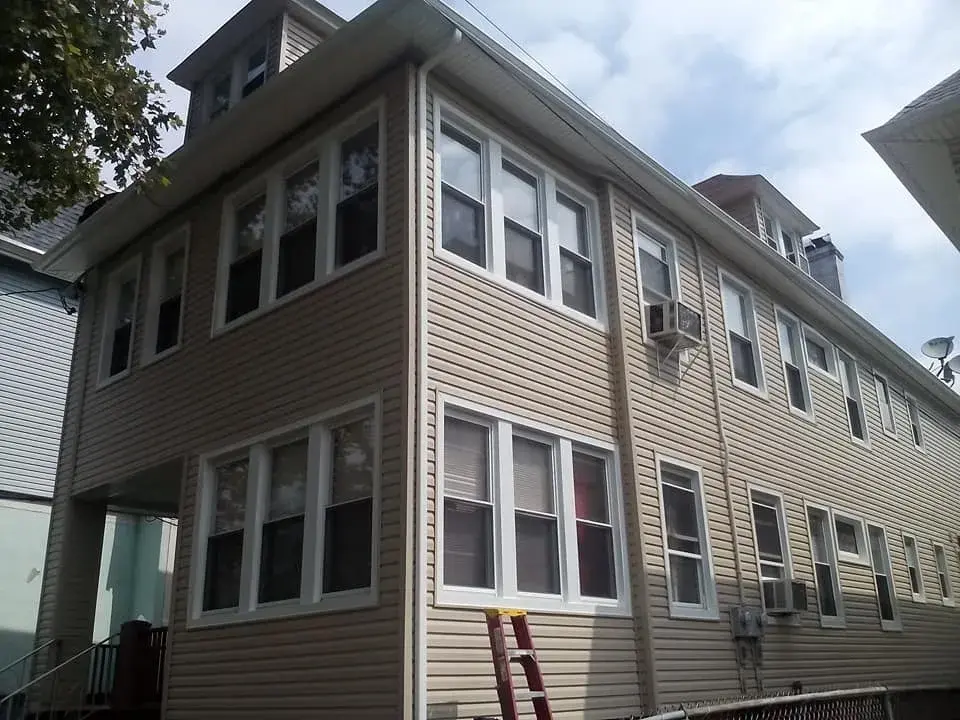
You can also review our siding work samples to see examples of completed exterior work.
My Recommendation for NJ Commercial Property Owners
If you are still deciding, I recommend starting with this shortlist:
Choose vinyl when initial budget and low routine maintenance are the main priorities.
Choose fiber cement when you want a durable, attractive, long-term exterior.
Choose metal for industrial properties, modern designs, and large straightforward elevations.
Choose EIFS when continuous insulation and a smooth architectural façade are central to the project.
The right answer may also be a combination. For instance, a retail property might use fiber cement at the customer-facing entrance, metal panels around a new addition, and a more economical material on less visible elevations.
A careful material decision can improve your building’s appearance, protect the structure, and make future maintenance more predictable. If you are planning commercial siding installation in NJ, contact J&L Construction & Restoration to discuss your building, priorities, and next steps. A well-planned exterior upgrade turns a complicated project into a durable asset for your property.
Comments